Bambu Lab H2D 3D Printing Farm
Our Production Equipment
Forge Heights operates a dedicated farm of six Bambu Lab H2D 3D printers.
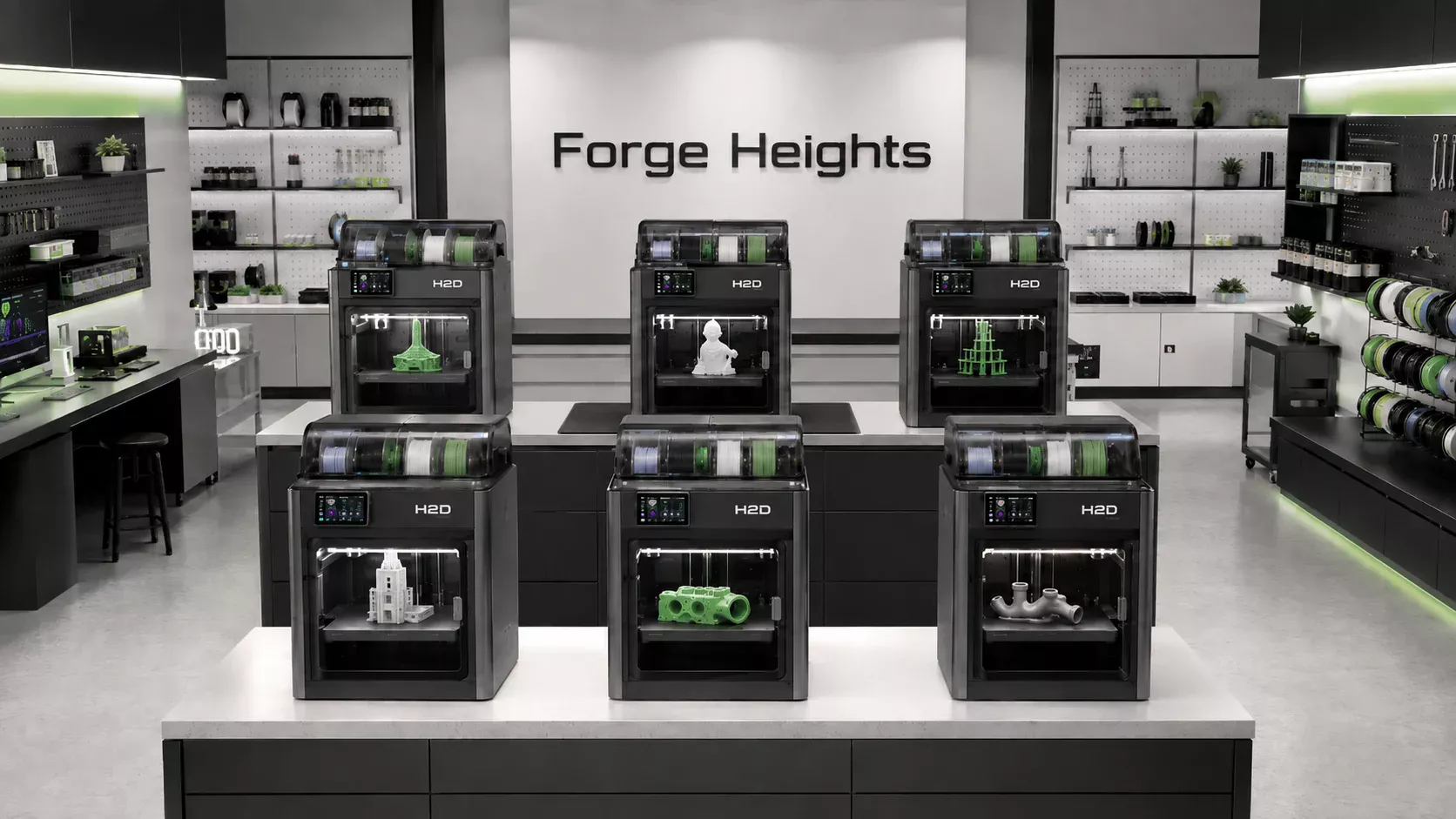
Six standardized H2D production systems give Forge Heights parallel capacity, repeatable workflows, and production redundancy.
Standardizing our production around one printer platform helps us maintain repeatable settings, material profiles, maintenance procedures, and quality-control practices across the shop.
It also gives us something a single-printer operation cannot: parallel production and redundancy.
Six Bambu Lab H2D Printers
The Bambu Lab H2D is a dual-nozzle CoreXY manufacturing platform designed for multi-material and engineering-material printing.
Capabilities that are especially useful in our production environment include:
- Dual-nozzle 3D printing
- A large print workspace of up to 350 × 320 × 325 mm
- Hotend temperatures up to 350°C
- Active chamber heating up to 65°C
- High-speed CoreXY motion
- Support for engineering and fiber-reinforced filaments
- Multi-material and multi-color manufacturing
- Dedicated support-material workflows
- Automated calibration, sensing, and print-monitoring systems
Not every Forge Heights product needs every H2D feature. The advantage is having those capabilities available when a design benefits from them.
Why Six Printers?
Parallel Production
Six production machines allow multiple jobs to run at the same time.
That is useful for:
- Small-batch manufacturing
- Multi-part products
- Restocking popular items
- Made-to-order products
- Different color and material runs
- Long-duration prints
A large job does not have to stop the rest of the shop.
Production Redundancy
3D printers are machines, and machines occasionally need maintenance.
With six H2D printers, one machine can be cleaned, serviced, calibrated, or configured for a different material without shutting down the entire production workflow.
That redundancy helps keep orders moving.
Consistent Workflows
Operating the same printer platform across the farm lets us standardize:
- Printer profiles
- Filament profiles
- Nozzle configurations
- Build surfaces
- Calibration routines
- Maintenance procedures
- Quality checks
A proven production job can be moved between compatible machines without rebuilding the manufacturing process from scratch.
Dual-Nozzle Manufacturing
The H2D’s dual-nozzle architecture gives Forge Heights additional flexibility for functional parts.
Depending on the design, dual nozzles can support:
- Multiple materials in one part
- Multiple colors
- Dedicated support materials
- Different nozzle configurations
- Reduced material changes during complex jobs
Dedicated support material can be particularly useful when a product requires supported surfaces with cleaner interfaces or easier support removal.
Materials We Work With
Our H2D farm gives us the flexibility to manufacture with a broad range of materials.
Depending on the product and application, that can include:
- PLA and PLA+
- PETG
- TPU
- ABS
- ASA
- Polycarbonate
- Nylon
- Carbon-fiber reinforced materials
- Glass-fiber reinforced materials
Material selection is based on what the finished part needs to do.
A product intended for a desk does not necessarily need the same material as one exposed to higher temperatures, sunlight, flexing, moisture, or mechanical loads.
Engineering-Material Capability
The H2D platform’s 350°C hotend and 65°C actively heated chamber expand the range of materials we can consider for functional products.
A controlled chamber is especially useful for materials that are more sensitive to cooling, thermal contraction, and warping.
That does not mean every product should be printed in an engineering filament. It means we have more manufacturing options when the application calls for them.
Monitoring and Quality Control
Modern printer automation helps us detect and prevent problems, but automation is only part of the process.
Forge Heights production also relies on:
- Properly prepared filament
- Tuned material profiles
- Clean and appropriate build surfaces
- Routine printer maintenance
- Visual inspection
- Dimensional checks when appropriate
- Final inspection before packaging
The goal is repeatability—not simply starting a print and hoping for the best.
Small-Batch Manufacturing Without Traditional Tooling
Traditional manufacturing can require molds, dies, fixtures, or significant machine setup before the first production part is made.
Additive manufacturing changes that equation.
Our six-machine farm is well suited to:
- One-off parts
- Short production runs
- Niche products
- Product revisions
- Multiple material or color combinations
- Customized variations
When a design changes, the updated digital model can move into production without waiting for new injection molds or other dedicated tooling.
Built to Scale with the Shop
Six H2D printers let Forge Heights balance catalog inventory, custom work, and made-to-order products across the same production environment.
Jobs can be distributed based on material, print duration, nozzle requirements, product priority, and current machine availability.
That gives us the flexibility of a small shop with the production capacity of a dedicated printer farm.
Six printers. One production standard.
Forge Heights
Made digitally. Manufactured locally. Built to be useful.