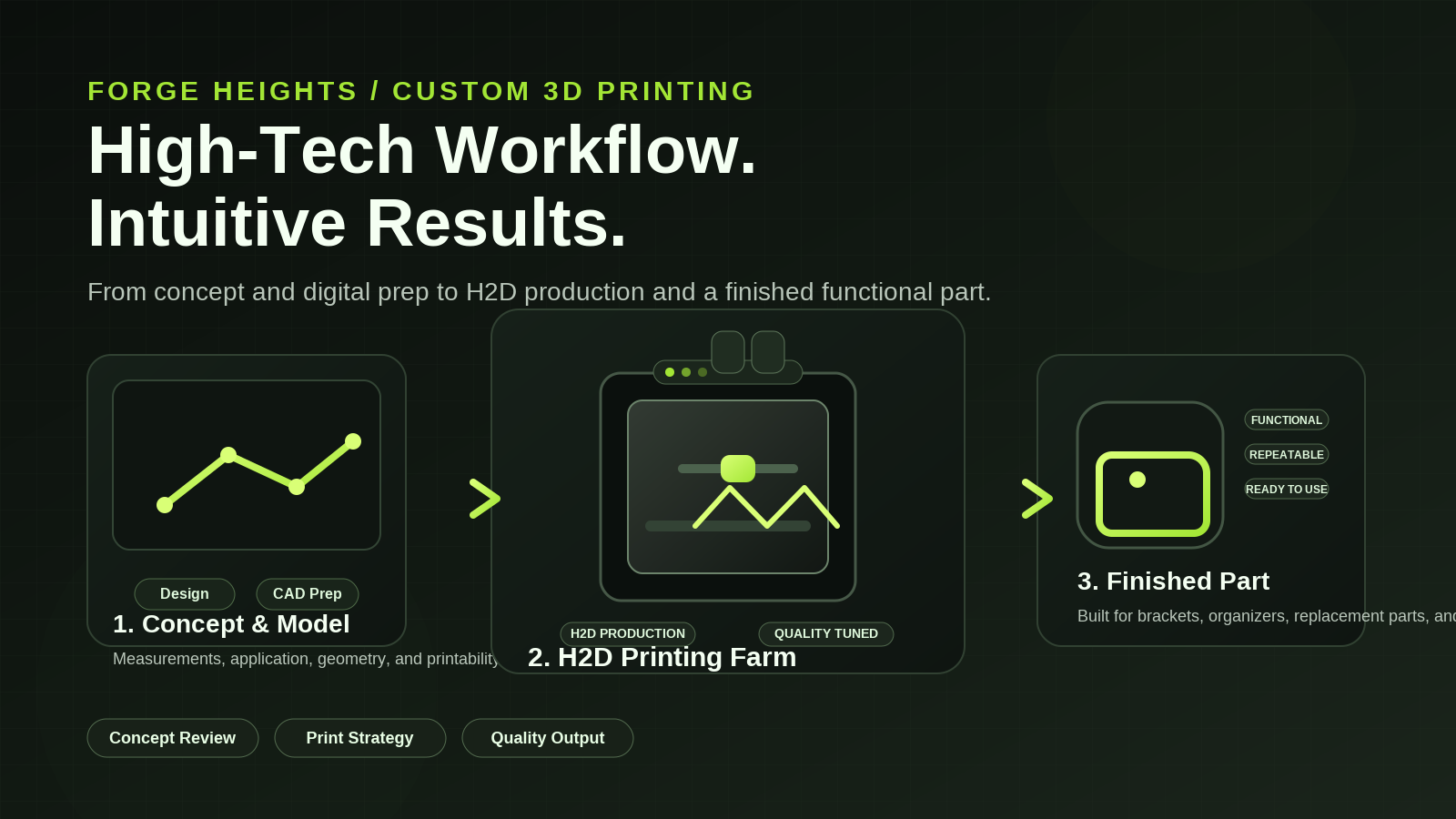
Forge Heights provides custom 3D printing and small-batch additive manufacturing for individuals, hobbyists, makers, businesses, and organizations.
Our focus is primarily on functional parts and practical products rather than high-volume commodity printing.
Projects may include replacement parts, brackets, organizers, enclosures, mounts, prototypes, hobby components, fixtures, adapters, custom-sized versions of existing products, and short production runs.
If you already have a printable model, you can send it to us for review. If you only have measurements, drawings, photographs, or an idea, tell us what you are trying to accomplish and we can determine the next step.
How the Custom Order Process Works
1. Send Us Your Project
Use our secure contact form to describe what you need.
You can attach supported project files including:
- 3MF
- STL
- STEP
- DOC
- TXT / text files
- SVG
- JPG / JPEG
- PNG
Include as much useful information as possible, such as:
- Intended use
- Approximate dimensions
- Quantity
- Preferred material
- Preferred color
- Required deadline
- Heat or outdoor exposure
- Mechanical loads or flexibility requirements
- Any critical dimensions or mating parts
The more we understand about the application, the better we can recommend an appropriate manufacturing approach.
2. File and Application Review
We review the project for printability and manufacturing considerations such as:
- Model geometry
- Dimensions
- Print orientation
- Supports
- Wall thickness
- Clearances and tolerances
- Material suitability
- Expected strength
- Surface requirements
- Production time
If we identify something that may affect the finished part, we will discuss it with you before production.
3. Material and Manufacturing Recommendation
When appropriate, Forge Heights may recommend a different material, print orientation, wall thickness, infill strategy, support method, or other manufacturing change based on how the part will be used.
The most expensive material is not automatically the best material.
Our goal is to use the material and process that make sense for the actual application.
4. Quote and Approval
You receive a quote describing the project, quantity, selected material, expected production time, and price.
Custom manufacturing does not begin until the quote has been approved and the required payment has been received.
If the project changes after approval, we may issue a revised quote before continuing.
5. Production
Approved projects are scheduled on our six-printer Bambu Lab H2D production farm.
Parts are manufactured using the agreed material and production approach, then inspected before shipment or pickup.
6. Delivery
Completed orders are packaged and shipped using the shipping method shown on the order.
Tracking information is provided when available.
Shipping/transit time is separate from production turnaround time.
Materials
Forge Heights works with a variety of consumer and engineering-grade thermoplastics.
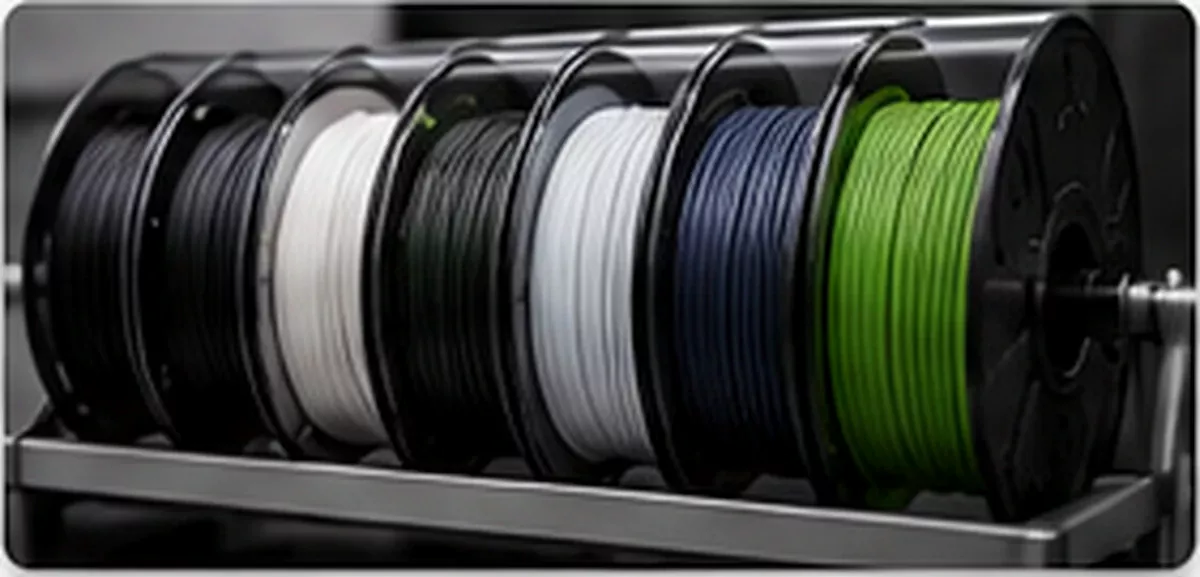
Material selection is based on the finished part’s environment, strength, flexibility, temperature exposure, appearance, and intended use.
Material availability depends on the requirements of the project, filament inventory, color availability, printer configuration, and intended use.
PLA / PLA+
PLA and PLA+ provide excellent surface quality and dimensional accuracy and are well suited to many indoor applications.
Common uses include:
- Prototypes
- Organizers
- Housings
- Decorative components
- Fixtures
- Display parts
- General indoor products
PLA is generally not our first recommendation for parts exposed to prolonged heat, outdoor weather, or significant mechanical loading.
PETG
PETG is one of our most commonly used materials for functional parts.
It provides a useful combination of:
- Toughness
- Moisture resistance
- Good dimensional stability
- Better temperature performance than standard PLA
- General-purpose durability
PETG is often a good choice for brackets, housings, organizers, equipment accessories, workshop parts, and everyday functional products.
ASA
ASA is a strong option when a part requires improved heat resistance, outdoor durability, or UV resistance.
Typical applications may include:
- Outdoor accessories
- Exterior housings
- Equipment mounts
- Automotive-adjacent accessories
- Parts exposed to sunlight
- Parts exposed to moderately elevated temperatures
TPU
TPU is a flexible thermoplastic used when a part needs to bend, compress, grip, absorb vibration, or provide impact protection.
Applications may include:
- Protective covers
- Feet
- Bumpers
- Flexible inserts
- Grips
- Gaskets
- Vibration-isolating components
TPU availability and hardness depend on the project.
ABS
ABS can be useful for functional parts requiring better heat resistance than standard PLA.
Depending on the application, Forge Heights may recommend ASA or another material when it offers better performance for the intended environment.
Polycarbonate and Nylon
Polycarbonate and nylon are available for selected engineering applications requiring greater toughness, heat resistance, impact resistance, or mechanical performance.
These materials require additional manufacturing controls and may carry additional material and production charges.
Carbon-Fiber and Glass-Fiber Reinforced Materials
Selected projects can be manufactured using carbon-fiber or glass-fiber reinforced filaments.
These materials may provide:
- Increased stiffness
- Improved dimensional stability
- Improved temperature performance
- Reduced warping in some applications
- A specialized surface appearance
Fiber-reinforced materials are abrasive and require specialized printer components and manufacturing procedures, so additional charges may apply.
Colors
A variety of colors may be available depending on the selected material.
Color availability can change as filament inventory changes, and exact shades may vary between manufacturers and production batches.
If color matching is important, tell us before approving the order.
Unless specifically agreed upon, Forge Heights cannot guarantee an exact match to:
- A computer monitor
- A photograph
- A paint sample
- A Pantone color
- A previously manufactured item
Turnaround Time
Most custom orders are completed approximately 3–7 business days after final approval and payment.
Simple projects may be completed sooner.
Additional production time may be required for:
- Large parts
- Long-duration prints
- Multi-part projects
- Engineering materials
- High quantities
- Complex support requirements
- Design revisions
- Specialty filament that must be ordered
- Projects requiring prototypes or fit testing
Your quote will include an estimated production timeframe whenever possible.
The production clock begins only after we have received everything required to manufacture the order, including:
- Final files
- Material choice
- Color choice when applicable
- Quantity
- Quote approval
- Required payment
Shipping time is additional.
Rush production may occasionally be available depending on printer capacity and material inventory. Additional charges may apply.
Pricing
Custom 3D printing is priced according to the specific project.
Pricing may include:
- Material consumption
- Machine time
- Printer setup
- Support material
- Part complexity
- Post-processing
- Quantity
- Engineering-material requirements
- Packaging
- Shipping
- Design or CAD work when requested
Ordering several identical parts may reduce the effective cost per part because setup and preparation work can be distributed across the production run.
A quote is provided before manufacturing begins.
Payment
Custom orders generally require payment before manufacturing begins.
Payment confirms approval of the project specifications described in the quote, including:
- Design/file revision
- Quantity
- Material
- Color when applicable
- Price
- Production plan
For unusually large projects or production runs, Forge Heights may offer deposit or milestone-based payment arrangements at our discretion.
Work will not begin until the required payment has been received.
Customer-Supplied Files and Intellectual Property
Customers are responsible for ensuring they have the legal right to reproduce any models, designs, logos, artwork, trademarks, or other intellectual property submitted to Forge Heights.
By submitting a file for manufacturing, you represent that you own the design or have permission to have it reproduced.
Forge Heights reserves the right to decline projects that we reasonably believe violate:
- Intellectual-property rights
- Applicable laws
- Safety requirements
- Forge Heights manufacturing policies
Customer-provided dimensions and model geometry are assumed to be intentional unless otherwise discussed.
We will point out obvious concerns when we notice them, but Forge Heights is not responsible for design errors contained in a customer-supplied model.
Design and File Preparation
Not every 3D model is automatically ready for manufacturing.
A model may require changes to:
- Wall thickness
- Tolerances
- Unsupported geometry
- Orientation
- Hole sizing
- Clearances
- Fit
- Small features
- Support strategy
Minor manufacturing preparation may be included with some projects.
Projects requiring substantial CAD work, model repair, reverse engineering, measurement, redesign, or creation of a new model may require a separate design charge.
Any design charges will be discussed before work begins.
Dimensional Accuracy and Tolerances
FDM 3D printing is a highly repeatable manufacturing process, but it is not the same as CNC machining or injection molding.
Small dimensional variations are normal.
Features that may require additional tolerancing or prototype iterations include:
- Holes
- Press fits
- Snap fits
- Threads
- Mating surfaces
- Bearings
- Sliding parts
- Mechanically interacting components
If your project has a critical dimension or required tolerance, tell us before we quote the project.
A dimension shown in a customer-provided model should not automatically be considered a guaranteed finished dimension unless that tolerance has been specifically discussed and accepted.
What a 3D Printed Part Looks Like
FDM parts are manufactured one layer at a time.
Normal characteristics of additive manufacturing can include:
- Visible layer lines
- Seam locations
- Small support marks
- Minor surface texture variations
- Slight differences between surfaces based on print orientation
These characteristics are normal and are not automatically considered defects.
We optimize orientation and manufacturing settings around the needs of the project, but a 3D printed surface will generally differ from an injection-molded or CNC-machined component.
If cosmetic appearance is especially important, discuss that requirement with us before ordering.
Inspection and Quality Control
Custom parts are inspected before shipment.
Depending on the project, inspection may include:
- Visual examination
- Basic dimensional checks
- Verification of material and color
- Quantity verification
- Fit checks when mating components are available
- Review for obvious print defects
If we identify a manufacturing problem before shipment, the affected part will normally be reprinted before the order is released.
Custom Order Refund and Resolution Policy
Because custom products are manufactured specifically for an individual customer, custom orders are final and are not eligible for cash or payment-method refunds for change of mind, ordering the wrong size, customer-supplied design errors, or deciding that the item is no longer needed.
If Forge Heights makes a manufacturing error, ships the wrong item, uses the wrong agreed material or color, or produces a part that materially differs from the approved order, we will work to correct the issue.
Our normal resolution will be one of the following:
- Reprint or replacement of the affected part, or
- Forge Heights store/account credit
The appropriate resolution will depend on the circumstances.
If a replacement can reasonably correct the problem, our first option will normally be to manufacture the affected part again.
We may request:
- Photographs
- Measurements
- A description of the issue
- Additional troubleshooting information
- Return of the original part when appropriate
Cash or payment-method refunds are not normally provided for custom-manufactured products, except where required by applicable law.
Problems should be reported promptly after delivery so that we can evaluate the part and the manufacturing records associated with the order.
Prototype and Fit-Test Orders
Some designs cannot be fully validated until a physical part has been manufactured and tested in its intended application.
This is especially common with:
- Tight fits
- Mating components
- Reverse-engineered parts
- Unusual geometry
- Customer-measured replacement parts
- Snap fits
- Press fits
- Assemblies involving existing hardware
For these projects, we may recommend manufacturing a prototype before producing the full quantity.
A prototype that accurately matches the approved design is considered a completed manufacturing service even if testing later shows that the design needs adjustment.
Subsequent design revisions, additional prototypes, or further manufacturing may incur additional charges.
Safety-Critical Applications
Consumer and small-batch additive manufacturing is not appropriate for every application.
Forge Heights may decline projects intended for applications where failure could reasonably result in serious injury, loss of life, or substantial property damage.
Examples include:
- Critical medical devices
- Life-support components
- Certified protective equipment
- Pressure-containing components
- Critical vehicle safety components
- Structural lifting equipment
- Other safety-critical applications
A 3D printed component should never be assumed to have a particular structural rating, certification, or regulatory approval unless that requirement has been specifically documented and independently validated.
Small-Batch Production
Need more than one?
Our six-printer Bambu Lab H2D production farm allows Forge Heights to handle both one-off custom parts and small production runs.
Multiple standardized machines allow us to manufacture compatible jobs in parallel while maintaining consistent:
- Printer profiles
- Material profiles
- Nozzle configurations
- Calibration procedures
- Quality-control processes
For larger quantities, contact us with the required quantity and expected delivery schedule so we can determine the most practical production plan.
Learn more about our production equipment →
Ready to Get Started?
Tell us what you need and what the finished part needs to do.
Helpful information includes:
- Intended application
- Approximate dimensions
- Quantity
- Environment
- Expected loads
- Heat exposure
- Material preference
- Color preference
- Deadline
- Critical dimensions
- Existing design files or documentation
You can attach supported design files directly through our secure contact form.
Forge Heights
[email protected]
Made digitally. Manufactured locally. Built to be useful.
Custom 3D Printing in Baltimore County and Maryland
Forge Heights serves customers in Baltimore County, Maryland, and across the United States through online project requests. We manufacture practical 3D printed replacement parts, prototypes, mounts, brackets, enclosures and short production runs. Submit dimensions, photos and CAD files through our custom quote request so we can review suitability, materials, quantity and shipping before providing a quote.
How to request a functional 3D printed part
Share the intended use, approximate measurements, material requirements and any available STL, STEP or 3MF files. If you are unsure which material is suitable, start with the expected temperature, outdoor exposure and mechanical loading. We can discuss whether PLA+, PETG, ASA, TPU or another material is appropriate for the application.